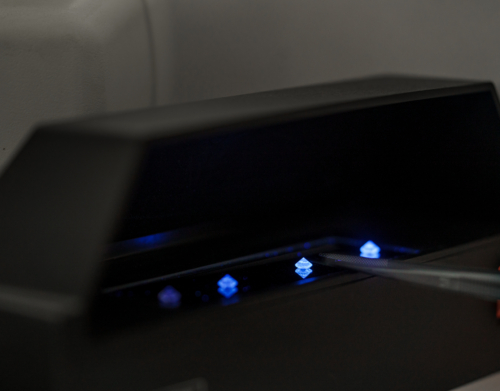
Fluorescence in diamonds is one of the most misunderstood details on a grading report, often raising questions about what fluorescence in a diamond is and how it should be understood. It’s a natural glow that some diamonds reveal when exposed to ultraviolet light. The reaction is subtle and often invisible in everyday indoor lighting, but in stronger UV conditions (such as direct sunlight or under a black light), a soft glow can appear. This glow is not created by an artificial process. It is the product of the diamond’s geological journey, as it formed over millions and billions of years ago deep within the Earth – one of Mother Nature’s magic tricks.
Within ORIGIN De Beers Group diamonds, these natural details are not treated as technical extras. Each diamond* is traced from source to jewelry setting, allowing characteristics like fluorescence to be understood as part of a larger story, connecting what you see to where the diamond began and how it formed.
What Does Fluorescence Mean In A Diamond
A clear fluorescence definition is based on how the diamond responds rather than how it looks.
Fluorescence is the glow emitted from the diamond when it’s exposed to ultraviolet light. This glow is the result of the light reacting with nitrogen atoms, guest elements in the diamond, that have moved into groups throughout the crystal over millions of years. These friendly configurations of nitrogen atoms will briefly absorb that invisible light, only to then release it as a soft, visible glow. The effect varies from one diamond to another and disappears as soon as the light source is removed, leaving the diamond unchanged.
Beyond the science, fluorescence matters because it adds another layer to a diamond’s uniqueness. Not all natural diamonds visibly fluoresce, and when they do, the intensity and color reflect their journey across millions of years; from where, when and how they formed, to their adventure to the surface. For those interested in origin and formation, characteristics like diamond fluorescence offer insight into the natural conditions that shaped it. For some, this becomes a visible trace of that journey, adding depth when choosing a diamond that’s right for you.
What Does Fluorescence Look Like in Real Life?
During daily wear, fluorescence in diamonds is usually not visible. In most diamonds, fluorescence appears as a soft blue glow under UV light. The effect can range from very subtle (none/negligible) to clearly visible (very strong), depending on intensity.
In rare cases, very strong fluorescence may create a slightly softened or diffused appearance in certain lighting conditions.
You are most likely to see fluorescence in these environments:
- Under a jeweler’s LWUV (long-wave ultraviolet) pen
- In clubs or spaces with black light (black light is LWUV light)
- In strong midday sunlight, which contains higher levels of natural UV
Why diamonds glow under UV light
Diamonds glow under UV light because of the natural conditions in which they formed. Subtle variations within the diamond’s structure allow it to interact with ultraviolet light in a way that produces a visible glow.
This effect happens instantly when UV light is present and disappears just as quickly when it is removed. The diamond itself remains unchanged. Fluorescence does not affect durability or strength.
Instead, it is a natural response shaped during the diamond’s formation, one of the reasons to buy a diamond with a story.
Does a diamond’s fluorescence show in sunlight or indoor light?
- Indoors, fluorescence in diamonds is typically not visible. Most interior environments contain minimal ultraviolet light, so the diamond appears the same as it would without fluorescence.
- In direct sunlight, which includes higher levels of UV radiation, the effect may be detectable in diamonds graded medium, strong, or very strong fluorescence intensity. In most cases, this simply means the diamond seems a little brighter and whiter, especially in higher color grade, colorless diamonds. Even then, visibility depends on the intensity of the UV exposure and the individual diamond.
- In shaded outdoor settings or diffused daylight, the reaction is often minimal. For many diamonds, fluorescence has little to no impact on how the diamond looks in everyday conditions.
Common diamond fluorescent colors
Blue is the most common fluorescence color in diamonds. Rarer colors include yellow, white, green, or red, and are usually noted clearly on a grading report. It’s important to note that if a diamond does not have a report, and rarer fluorescence colors are observed in colored diamonds, the color origin should be checked. These different fluorescence reactions can be a result of artificial treatments used to enhance the color.
If you are exploring loose diamonds or diamonds already set in jewelry, view them in different lighting conditions: indoors, in daylight shade, and under UV light if possible. This allows you to see how characteristics like fluorescence express themselves across environments.
How Fluorescence is Graded on Diamond Reports
Fluorescence in diamonds is graded by intensity. It is not a measure of beauty or rarity. It records how a diamond reacts when exposed to ultraviolet light.
Grading reports issued by the Gemological Institute of America (GIA) or the De Beers Institute of Diamonds include fluorescence as a separate line item.
Diamonds examined for ORIGIN De Beers Group are assessed using advanced UV technology. These include deep-UV surface imaging instruments that allow experts to observe growth patterns in a diamond, helping distinguish natural formation from laboratory grown diamonds, which display a very different growth pattern and fluorescence response.1
Within ORIGIN De Beers Group diamonds, this recorded detail adds to a broader understanding of each diamond’s formation and individuality.
None, faint, medium, strong, and what they mean
- None/Negligible: No visible reaction under ultraviolet light.
- Faint: A minimal glow under UV exposure. In most cases, it has no visible impact in everyday lighting.
- Medium: A noticeable glow under UV light. Observing it across lighting conditions helps reveal how this natural characteristic presents.
- Strong or Very Strong: A pronounced reaction under UV exposure. Viewing it in everyday lighting allows you to understand how the diamond maintains its clarity and brightness while expressing this effect.
Intensity vs color
Grading reports typically list fluorescence by intensity first, followed by color. For example, “Medium Blue.”
Intensity refers to the strength of the reaction under ultraviolet light. Color describes the hue of the visible glow, most commonly blue.
The definition of fluorescence in diamonds relates to reaction strength, not aesthetic value. A grading report provides standardized information, but visual assessment remains important to understand how the diamond appears in the lighting conditions where it will actually be worn.
When Fluorescence Matters and When It Doesn’t
A fluorescence response will very rarely negatively impact the diamond’s appearance, such as causing it to seem hazy. It will only ‘brighten and lighten’ the diamond, with a blue fluorescence counteracting any yellow tones, giving the appearance of a higher color grade.
Fluorescence becomes noticeable only in certain lighting conditions. In many everyday settings, particularly indoors, it has little visible impact. In environments with higher ultraviolet light, such as direct sunlight or under black light, some diamonds may reveal a soft glow.
With ORIGIN De Beers Group diamonds, fluorescence is not treated as something to question or judge. It moves beyond the idea of whether fluorescence is good or bad in diamonds, and instead becomes part of what makes each diamond distinct.
Fluorescence is worth closer attention when:
- In stronger UV environments, such as direct sunlight or under black light, where the diamond may reveal a soft, often blue glow
- In diamonds with medium to very strong fluorescence, where this natural effect becomes more visible and expressive
- When viewing a diamond across different lighting conditions, allowing you to see how it responds in each setting
When fluorescence is less visible
- In diamonds graded none or faint, where the effect is minimal.
- In indoor environments, where UV exposure is limited
- When the diamond is viewed in lighting that emphasizes brilliance and light return.
Fluorescence is not about deciding whether it should be present. It is about understanding what it reveals. This subtle glow is a visible trace of their formation, a quiet detail that speaks to their origin and individuality.
When choosing a diamond, consider how this characteristic fits into the story you are drawn to and how it reflects the journey that brought that diamond to you.
Fluorescence Adds to the Story
Fluorescence is one of many natural characteristics that make each diamond unique. It is measurable and documented, a part of how a diamond interacts with light and carries the memory of its formation. But it is also something more: a moment of magic that connects a diamond to the extraordinary geological conditions that created it.
This is precisely why ORIGIN De Beers Group includes fluorescence as part of the recorded profile of each diamond. Fluorescence is not a caveat or a complication. It is a detail that deepens the narrative, adding another layer to a story that began billions of years ago and continues in the hands of the person who chooses it.
With ORIGIN De Beers Group diamonds*, every diamond comes with clear documentation and a recorded journey, tracing its path from source to setting. This transparency ensures that characteristics like fluorescence are understood not as isolated data points, but as part of what makes each diamond singular. Each detail contributes to a story that is shaped by nature, recorded over time, and ultimately chosen by you.
*Above 0.3ct


