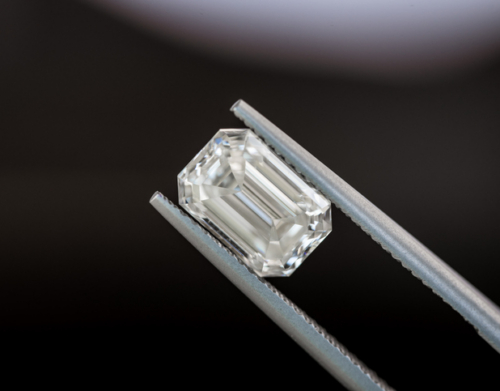
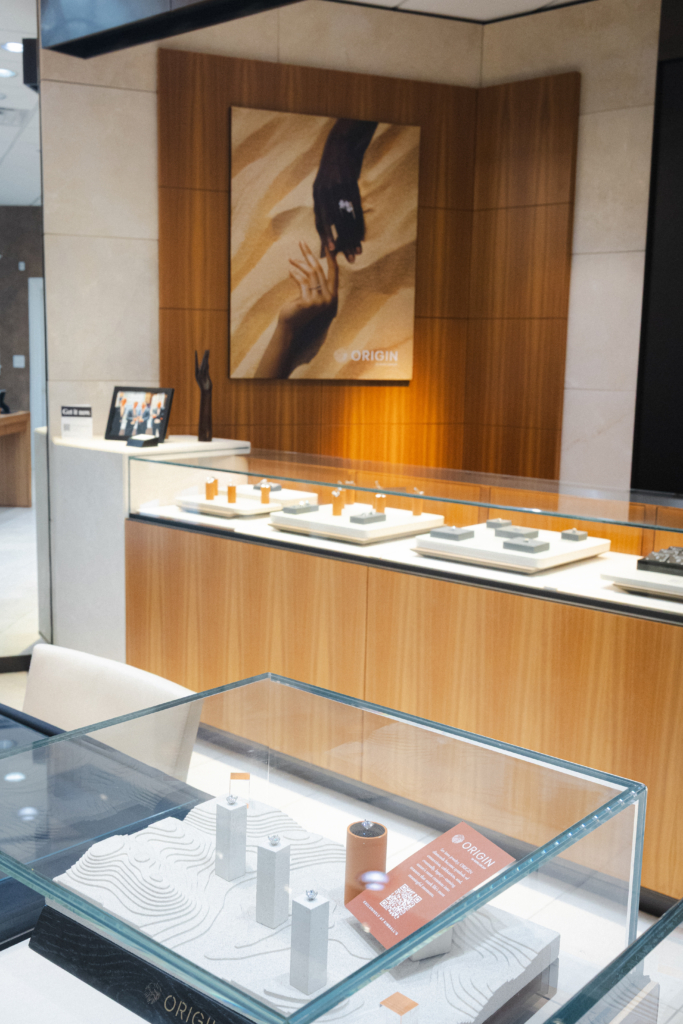
Kyle Foster is a fourth-generation jeweler who now helps lead operations, sales, and diamond purchasing at Kimball’s Jewelers in Knoxville, Tennessee, one of the oldest jewelry companies in the state, now in its 160th year. As Kimball’s is an ORIGIN De Beers Group retail partner, Foster spoke with us about his jeweler approach to settings, how he assesses a diamond before any setting decisions are made, and why starting with the diamond itself, rather than a style trend, changes the outcome.

READING THE DIAMOND FIRST
From a jeweler setting perspective, before any setting decisions are made, how do you assess a diamond’s shape, proportions, and presence on its own terms?
“Studying the diamond, and understanding that it is, for lack of a better word, almost alive in how it responds to light that we get to put into a beautiful piece of jewelry, really helps me understand the history and the structure of the diamond itself. I look for things like symmetry, the proportions, all of the technical terms we’re looking for, and then I immediately begin to explore how I can bring out the beauty and the story of this diamond, the kind ORIGIN’s recorded journey helps carry forward, while still keeping it safe and letting it live in that setting.”
Every ORIGIN De Beers Group diamond is selected first for its recorded journey and integrity, before any design work begins. How does starting with the diamond itself, rather than a style trend, shape your approach to diamond-centered jewelry design?
“I look for the traits within that diamond, its own characteristics, what makes it unique. Every diamond is a natural piece of the earth, and I’m looking for the specific characteristics that are going to give it life within the jewelry. What I love about ORIGIN De Beers Group diamonds is that we get to see the journey that diamond took to get to where it is in my hands today. We get to incorporate that into its setting as we move forward, as well as let customers become part of its story too.”
Natural diamonds form over millions, if not billions, of years, and no two are ever quite alike. Does that individuality ever surprise you when you’re designing a setting, in ways a client might not expect?
“Oh, absolutely. We see natural features within diamonds shaped like certain symbols we recognize, and I think that’s the beauty and the mystery of nature itself. These diamonds that come out of the ground will consistently surprise us. We see natural features that really give a diamond life and help customers understand that it’s a part of nature just as much as we are, and we’ve allowed it to become that beautiful, recognizable symbol.”
Can you share an example of a personalized setting selection, where the final design was shaped entirely by a diamond’s natural shape or character rather than a client’s original request?
“The one that comes to mind is a client who came in to upgrade her original engagement ring. She was well into her 30th or 40th anniversary with her husband, had children, and wanted to incorporate the children’s birthstones into the design. She came in with her own drawings, and her mind made up; she knew exactly what she wanted, and marquise cuts were at the top of her list. As we began looking through some of our diamonds, she came across a two-carat oval diamond, and you could see that spark in her eye the moment she realized it was the one.”
ENGINEERING THE SETTING
How do you approach custom ring engineering, deciding on a setting’s structure and metal choice so it protects the diamond while still letting its natural character come through?
“The beauty of a diamond needs to be protected first and foremost. I’m going to look for things like the structural weak points in specific cuts and shapes and then incorporate the client’s lifestyle as well: if someone works frequently with their hands, maybe we need to talk about a particular metal that’s going to be more durable. We’re not going to look at things that may be too thin. I’m looking for elements that are going to enhance the diamond’s beauty while keeping it protected and incorporating the design the client is looking for.”
What does security-focused design mean in practice, and how do you manage that aesthetic vs performance balance against a client’s desire for a particular look?
“Our job in the jewelry industry is to help guide our clients to the most practical, safest, and most beautiful option. I continue to work with clients and help them understand that while we may want that one-millimeter-thin band for a two-carat diamond, sometimes that’s not going to be the most practical. I help them understand what we can do, from a gemological standpoint, to protect their investment and the future of their diamond. Things like understanding the difference between setting styles, a cathedral versus a Tiffany setting, all help enforce security while maintaining the beauty of the design, to let the diamond shine.”
How does a setting need to perform differently for years of daily wear, compared to how it might look for only special occasion wear?
“There’s a vast difference between wearing your engagement ring every day versus wearing a ring you’ll wear maybe on date night, or once every month or so. That’s where design plays a part in it, and it comes from experience, from being able to work with the client to understand that, yes, we’re going to get them the design they want, but we need to talk about the practicality of the ring too. If you’re wearing it every day versus wearing it occasionally, that changes what we recommend for both design and security. For daily wear, that often means a lower profile, sturdier prongs, and a more scratch-resistant metal; for occasion-only pieces, we can be a little more adventurous with height or delicate prong work.”
How would you describe the difference between a setting that has been designed around a diamond, and one where the diamond feels like an afterthought?
“Far too often we see pieces with a beautiful ring design, and then they’re trying to put the circle peg into the square hole to make the diamond fit. We’ll often see a lack of symmetry, a lack of balance between the setting and the diamond. I’m really looking for that ebb and flow between the two, that congruency, where they play well with each other instead of competing with one another. I want the diamond to be the main component, to really shine, but still have the backing and the security of a setting that lets it be the main player.”
How does balancing light performance with long-term security change your approach to functional diamond settings, in details like prong count, metal thickness, or setting height?
“Light performance varies. You could have two of the exact same diamonds, geologically, that look completely different, so it all comes down to what the diamond looks like in your hand, in the light, for that client. I’m working with things like: do we need to bezel set this, do we need four prongs versus six for the security or for the setting, does it need to be a little taller so light can travel through it correctly and bring out the proportions the diamond is capable of? It all varies depending on the diamond. That’s really the beauty of natural diamonds: everything is different; everything plays its own part. There’s not one that’s ugly versus one that’s pretty, they all have their own special features.”
BUILT TO LAST
How does designing around a diamond’s natural character affect how a piece holds up, or gets passed down, over the years?
“Diamonds are a timeless symbol to me. Even with trends and fads coming through, we’re always going to see the beauty of a natural diamond passed down from generation to generation. Settings come and go, but as long as we’re protecting that diamond, it can be passed down. I recently reset a client’s great-grandmother’s natural diamond into a setting they felt more comfortable wearing, one that wasn’t as antiquated as the original. It really comes down to the beauty and protection of the diamond itself, so it can move from generation to generation, not only as an heirloom piece, but as something that may hold financial value moving forward too.”
What is one piece of advice you would give a client in finding a setting style that works best for their diamond?
“I always say start with the diamond first. Let’s not even talk about settings until we find the diamond that makes your eye sparkle just as much as the diamond does. Once we’ve done that, we can play around with what we think is the best option, both for security and design. I’ve always been a little headstrong, and I’ll tell a client honestly if I don’t think something looks good. I think clients appreciate that honesty, and it’s always nice to work with someone who understands that choosing a setting can be a flexible conversation, and that I’m not going to lead them astray just to make a quick sale. I want them to be happy customers for the rest of their lives. The setting is just as important as the diamond, so we talk about protection, design, and making sure it all works together.”
For Foster, and for other ORIGIN retail partners, the setting exists to support the diamond, not to compete with it: security first, beauty never compromised. It is a philosophy that begins even earlier, in choosing the diamond before the setting, and continues in what makes a diamond’s story part of its appeal.


