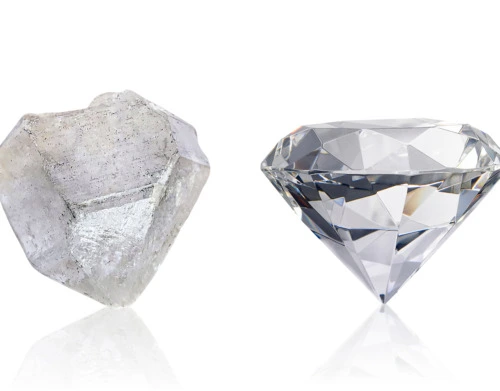
From the promise of marriage to the celebration of success, to the joy of welcoming new life, some moments deserve a symbol as enduring as a natural diamond.
And just as your journey through life is unique to you, every natural diamond also follows its own individual path. When you buy a diamond to celebrate these moments you may be curious about its beginnings, the landscapes that shaped it, the people connected to its journey, and the meaning it carries into the present.
To uncover that story, you need return to where it began: your diamond’s origin.
Diamond Origin: The Foundation of Trust
Without understanding your diamond’s origin, questions about your diamond may linger: Is it truly a natural diamond or is it lab-grown? Where was it discovered? Was it ethically and responsibly sourced? What journey has it taken?
A diamond’s brilliance alone can’t answer these questions, and yet they are essential for something as valuable, rare, and meaningful as a diamond.
In a market where untreated, treated, and lab-grown diamonds can appear almost identical to natural ones when viewed with the naked eye, connecting your diamond back to its origins reveals a deeper story. Having a provenance record means you can see every step of its journey from discovery to cutting to the moment it’s placed in your hand.
The journey of ORIGIN De Beers Group diamonds* is digitally recorded on Tracr™,1 the world’s leading digital platform for tracing natural diamonds, which enables the recording of information from where the diamond was discovered at source, to how it was recovered, and how it moved through expert hands. The ORIGIN De Beers Group diamonds’ traceability record affirms authenticity, gives confidence it’s a conflict-free diamond, and ensures the diamond’s journey can always be seen and followed.2
With ORIGIN De Beers Group diamonds, the story is clear. You’re not only choosing a diamond of the highest rarity, but also one that reflects your values and affirms your trust.
Ethical Diamond Sourcing and Community Impact
Today, choosing a natural diamond also means choosing a story of hope. Ethically sourced diamonds represent more than beauty; they reflect shared prosperity and responsible progress in diamond sourcing.
In 2024 alone, De Beers contributed $2.9 billion to the economies of Botswana, Namibia, South Africa, and Canada.3 These revenues support healthcare, education, and infrastructure, helping diamond-producing nations share directly in the value of their mined diamonds.
Responsible partnerships also keep skills and profits close to home. Since relocating its Global Sightholder Sales to Gaborone, Botswana in 2013, the country has become a global hub for the sorting and sale of rough diamonds. Local suppliers and cutting and polishing businesses are prioritized across southern Africa, with over 70% of De Beers’ procurement spend in 2024 directed to companies in producer countries.4
Ethical diamond sourcing and mining also looks to the future. Through programs like the Stanford Seed Transformation Programme, over 100 southern African businesses have raised capital, increased revenues, and created new jobs. Meanwhile, initiatives like EntreprenHER are supporting women entrepreneurs in Botswana, Namibia, and South Africa with grants, training, and mentorship.5
Knowing a diamond’s origin is more than assurance. With ORIGIN De Beers Group diamonds*, you can see the journey your diamond has taken and trust how it has been sourced, connecting it to the meaningful benefits created to help communities and nature along the way.


Business Responsibility: Ethics at Every Step
Launched in 2003, the Kimberley Process Certification Scheme (KPCS) has now been adopted by 85 countries, working to eliminate the trade in conflict diamonds.6 The World Diamond Council’s System of Warranties (SoW) further supports these efforts by requiring buyers and sellers to affirm that diamonds meet KPCS standards, extending ethical assurance from rough to polished diamonds and jewelry.7
The Best Practice Principles (BPP) launched by De Beers in 2005 also set strict ethical standards that go beyond conflict-free assurance.8 The BPPs set comprehensive ethical standards across business, social, and environmental practices. They require transparency, fair labor conditions, respect for human rights, and care for the environment, ensuring that every De Beers diamond is sourced with integrity and responsibility.
De Beers Group is also certified to the Responsible Jewellery Council (RJC) Code of Practices, a comprehensive standard covering ethical, social, human rights, and environmental requirements across the entire supply chain.9
For you, this means protection. Every ORIGIN De Beers Group diamond* is safeguarded by multiple layers of accountability. From source to sale, these frameworks are designed to strengthen integrity and transparency. Knowing your diamond’s origin is more than reassurance – with ORIGIN De Beers Group diamonds it’s integrity made visible.
Diamond Traceability as Proof of Integrity
Paper certificates can be lost or forged. True confidence comes from modern diamond tracing.
From the moment an ORIGIN De Beers Group diamond* enters the value chain, it’s registered on the Tracr™ platform with a unique digital ID. The country of discovery is recorded on the digital passport as is every transformation step along the way, as the diamond evolves from rough diamond to polished gem. Key stages of the diamond’s journey can be verified on the blockchain, creating a tamper-proof record that enhances transparency and traceability across the value chain. The Four Cs – cut, color, clarity, and carat – may determine a diamond’s price, but its transparent certification and traceability reveal a diamond’s truth.
Diamond Practices and Environmental Responsibility
If you believe your diamond purchase should reflect the beauty of its origin, then responsibility matters. A consumer-driven movement is reshaping the diamond industry, demanding ethical practices that help honor both communities and nature.
From large-scale conservation projects to commitments to renewable energy, sustainability is now a defining expectation for conscious consumers. De Beers Group reflects this through initiatives such as:
- Safeguarding conservation land: Across southern Africa, ORIGIN De Beers Group diamonds* help protect more than 200,000 acres of land helping to preserve biodiversity and sustain natural ecosystems.10
- Partnering with Indigenous knowledge: In Canada, six First Nations groups work alongside the Gahcho Kué Mine to help monitor its impact, combining traditional knowledge with science to help protect air, water, land, and wildlife.11
- Transitioning to clean energy: By 2026, Venetia Mine in South Africa will use 100% renewable electricity, generated by solar and wind, through a partnership with Envusa Energy.12
These projects form part of a wider commitment: recovering diamonds responsibly and helping to restore and preserve the environments from which they are sourced.
Emotional Significance and Personal Connection
Natural diamonds are storytellers. Every gem represents millions to billions of years of Earth’s history and that story is extended beyond its extraordinary geological journey. Knowing its origin connects a diamond’s brilliance to the nature it helps care for, communities it helps support, and values it upholds. When you choose a natural diamond, you add your own story to that journey.
And that diamond’s story does not end with you. One day, your diamond may become an heirloom, carrying forward not only its natural history but also your legacy of values, memories, and meaning.
* Above 0.3 cts
Sources
1. Tracr. “Home.” Tracr. (opens in new window)
2. De Beers Group. “Provenance and Industry Leadership.” De Beers Group. (opens in new window)
3. De Beers Group. “Partnering with Host Countries.” De Beers Group (opens in new window).
4. De Beers Group. “Partnering with Host Countries.” De Beers Group. (opens in new window)
5. De Beers Group. “Livelihoods.” De Beers Group. (opens in new window)
6. Kimberley Process. “What Is the Kimberley Process?” Kimberley Process. (opens in new window)
8. De Beers Group. “Best Practice Principles.” De Beers Group. (opens in new window)
9. Responsible Jewellery Council. Code of Practices (COP) 2019. PDF. (opens in new window)


